

Is the NFT Bubble Finally Bursting?
Concluding month, the Wall Street Journal reported that sales of NFTs were "flatlining", citing information from NonFungible, a information analytics visitor that covers the industry. On the face of it, the figures look stark: agile NFT wallets appear to take dropped 88%—from 119,000 to 14,000—since September final year, and private sales have dropped from a daily average of 225,000 to xix,000, a abrupt 92%. Worse, buyers are dwarfed by sellers past something like five to one.
A collapse on this scale would exist a severe accident to an industry that in 2021 saw over $17bn change hands, fuelling the hopes and dreams of thousands of artists who saw the engineering as a means to finally profit from their otherwise infinitely reproducible digital art. It would also exist a travesty for the collectors who were hoping to resell for a quick buck: the Wall Street Journal chronicles the travails of one Sina Estavi, who bought a screenshot of a Jack Dorsey tweet for $2.9m in March 2021 merely tin can no longer concenter a bid over $xiv,000. (He'south yet holding out, though—practiced for him.)
The problem is that these data practise non provide the full story. For a beginning, as NonFungible pointed out, the figures used were from the Q1 written report and we are now approaching Q2; things take changed, not to the lowest degree with a serial of new, lucrative collections like Moonbirds and Otherside. (NonFungible as well insisted its figures were "conservative".)
More than pertinently, NFTs are a vast and diverse asset class that defy attempts to explain their value in terms of one set of market principles. Sometimes they behave like avails in the traditional art market, with one-off pieces and collections produced by popular artists going for exorbitant sums based on a heady combination of perceived prestige and organized religion in an even more exorbitant resale price.
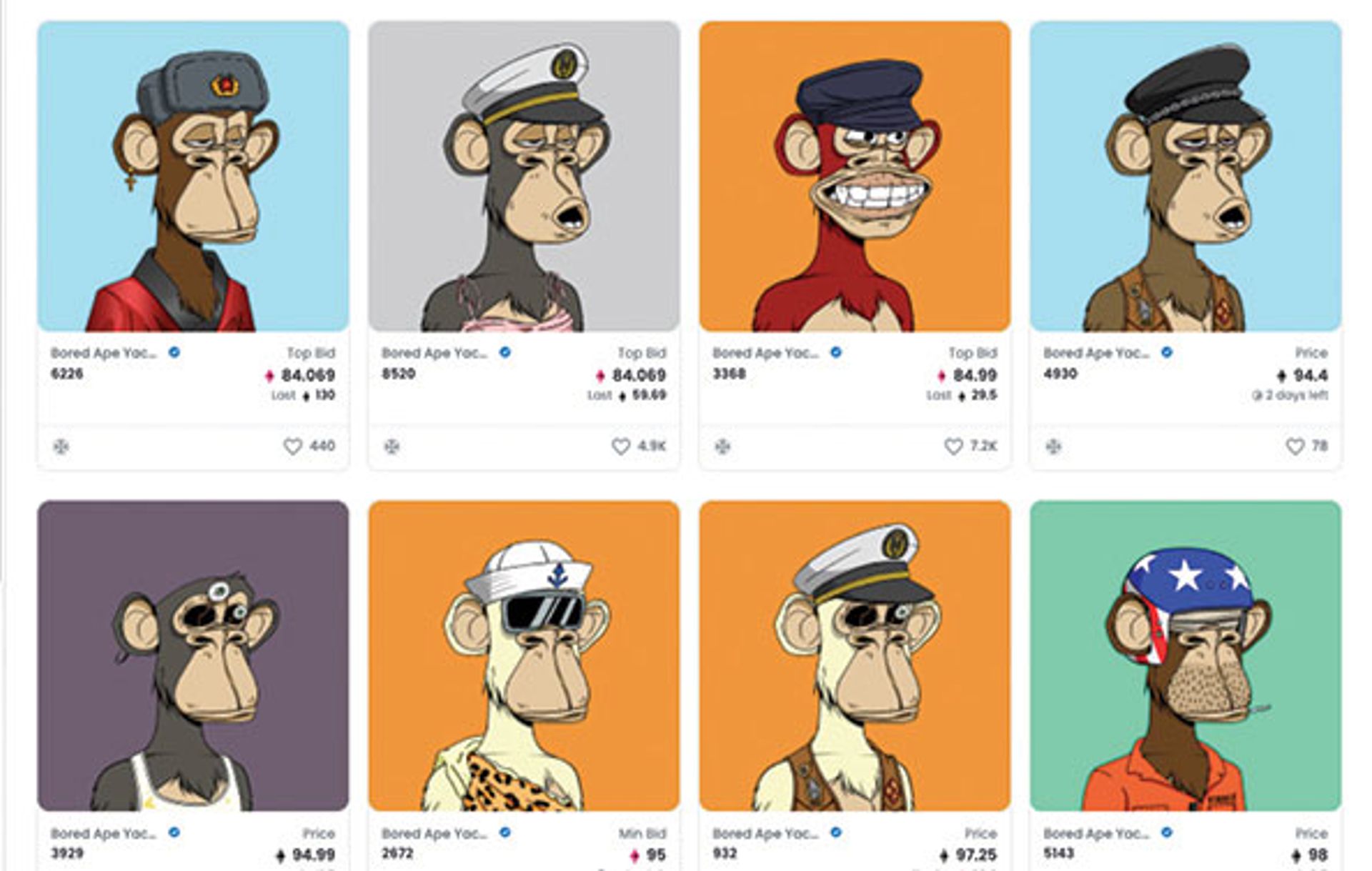
Likewise every bit behaving more like regular assets, NFT collectibles like Bored Apes may offer a package of exclusive privileges
© Bloomberg Finance LP
Exclusive privilege
But then in that location are the more recent groupings of NFTs: "profile-moving picture" avatars, such as Bored Apes, which form part of collections conferring some kind of exclusive privilege onto the holder like access to events, intellectual belongings, more than tokens and messaging boards. These behave more than similar mutual stock, or a digital asset like Bitcoin or Ethereum.
"The value of the pieces is derived quite differently," says Louisa Choe, an analyst at Nansen, a data firm that provides a more than circuitous overview of the NFT markets. "Pieces such every bit Bored Ape Yacht Club, Doodles and Azuki are 'social NFTs'—the core value is the identity they offer adopters." On the other hand, she says, the value of one-off works is "derived from the popularity and recognition of the artists".
Understanding this stardom results in a more nuanced appreciation of the market. Looking at the data, Choe observes that, since Apr, in that location has actually been a boost in NFT sales, evidenced by the increase in the ratio of wallets buying to wallets selling. (The Wall Street Periodical did not make this distinction.) While there has been some sell-off in cheaper tokens, she says, the information suggests that the sellers are non abandoning the market place but simply moving from one kind of NFT—the riskier "drops" past popular artists—onto better established collections that look similar a safer bet. Choe says that these social NFTs now command an 83% share of the NFT market; that'southward why she calls them "blueish chips". It'due south not dissimilar to the moves seen in the wider tech markets, which have been roiled by college interest rates.
Sam Williams, the main executive of the decentralised NFT database Arweave, says that collections expect safer to investors because they are able to draw in more liquidity—that is, more than potential buyers and sellers. One-off works generate huge supplies of buzz in the promise of attracting new buyers looking for a profitable resale, just over time that fizz will draw downward equally the new fad overtakes it—unless the work is an earth-shattering masterpiece or has some historical significance. That is what makes these works "non-fungible": each is unique and there is no equivalent you lot tin can trade it for. If the buzz fades, yous'll probably never find a buyer and you'll be stuck with an attractive waste material of money (unless you but like the art!) It besides makes reliable data hard to find: how, for case, is a digital work with neither buyers nor sellers valued at all? The prevalence of individual, proprietary auction houses and the phenomenon of launder trading, in which holders trade with themselves, doesn't aid either.
NFT collectibles, on the other hand, acquit virtually like regular avails. Bored Apes, for instance, muster large, devoted communities of holders of these mostly interchangeable primates, guaranteeing some caste of liquidity. "Those collections where there is a big customs and many tokens accept a slightly more 'fungible' market structure," Williams says. He explains that this is why the value of NFT collections is frequently adamant by a "floor price"—that is, the cheapest available of a given set. "People tend to exist willing to purchase whichever the cheapest one is, as long every bit they 'have a Bored Ape'," he says. (This is also why very few holders even pretend to care about the quality or, say, dialectical significance of the art.)
All this means that the Wall Street Journal wasn't exactly incorrect to notation a decline in the value of certain NFTs. But in reality the punters have but swapped one casino for another, moving from the sale firm to the trading floor.
Source: https://www.theartnewspaper.com/2022/06/06/has-the-nft-art-bubble-finally-burst-not-yet-new-data-suggests
Posted by: johnsonyoubtand.blogspot.com
0 Response to "Is the NFT Bubble Finally Bursting?"
Post a Comment