

What Does The Data Show About The Makeup Of Dna For Different Species?
Affiliate ix: Introduction to Molecular Biology
ix.1 The Structure of DNA
Learning Objectives
Past the cease of this section, y'all will exist able to:
- Describe the structure of Deoxyribonucleic acid
- Depict how eukaryotic and prokaryotic DNA is bundled in the cell
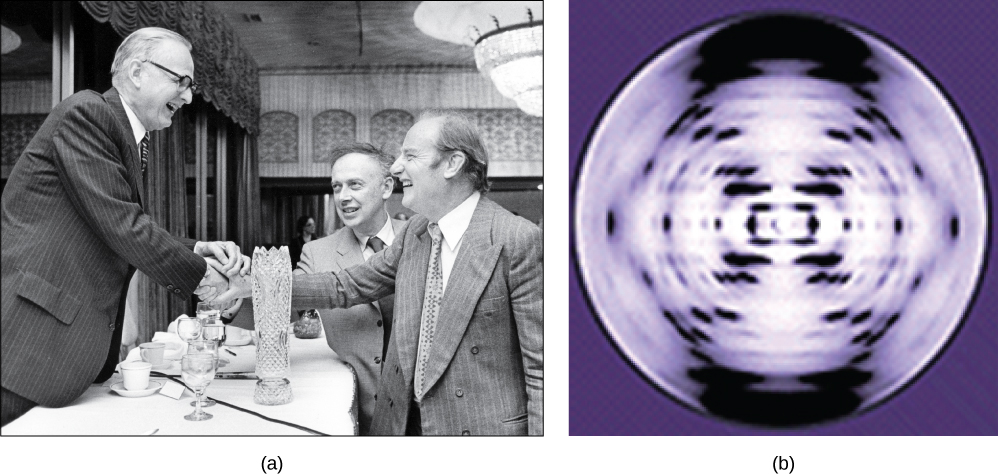
In the 1950s, Francis Crick and James Watson worked together at the Academy of Cambridge, England, to make up one's mind the structure of Dna. Other scientists, such as Linus Pauling and Maurice Wilkins, were also actively exploring this field. Pauling had discovered the secondary construction of proteins using X-ray crystallography. X-ray crystallography is a method for investigating molecular structure by observing the patterns formed by 10-rays shot through a crystal of the substance. The patterns give of import data about the construction of the molecule of interest. In Wilkins' lab, researcher Rosalind Franklin was using X-ray crystallography to empathize the structure of DNA. Watson and Crick were able to slice together the puzzle of the DNA molecule using Franklin's information (Figure 9.ii). Watson and Crick also had key pieces of data available from other researchers such equally Chargaff's rules. Chargaff had shown that of the iv kinds of monomers (nucleotides) present in a Deoxyribonucleic acid molecule, 2 types were always nowadays in equal amounts and the remaining two types were also always present in equal amounts. This meant they were ever paired in some way. In 1962, James Watson, Francis Crick, and Maurice Wilkins were awarded the Nobel Prize in Medicine for their piece of work in determining the structure of Dna.
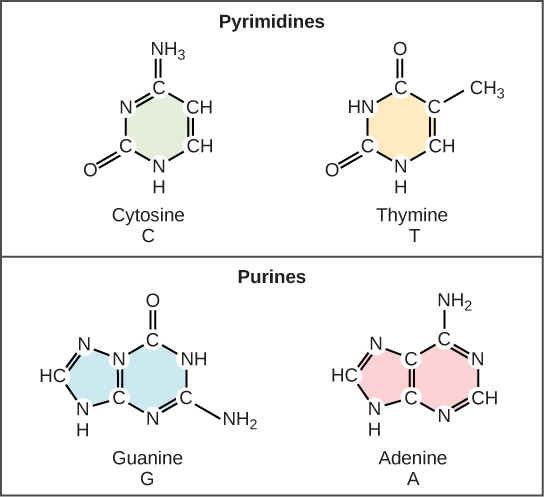
Now permit'southward consider the structure of the 2 types of nucleic acids, deoxyribonucleic acid (DNA) and ribonucleic acrid (RNA). The edifice blocks of Deoxyribonucleic acid are nucleotides, which are made up of three parts: a deoxyribose (5-carbon carbohydrate), a phosphate group, and a nitrogenous base (Figure 9.3). At that place are four types of nitrogenous bases in DNA. Adenine (A) and guanine (One thousand) are double-ringed purines, and cytosine (C) and thymine (T) are smaller, single-ringed pyrimidines. The nucleotide is named according to the nitrogenous base of operations it contains.
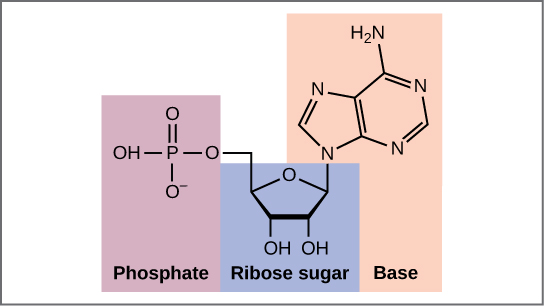
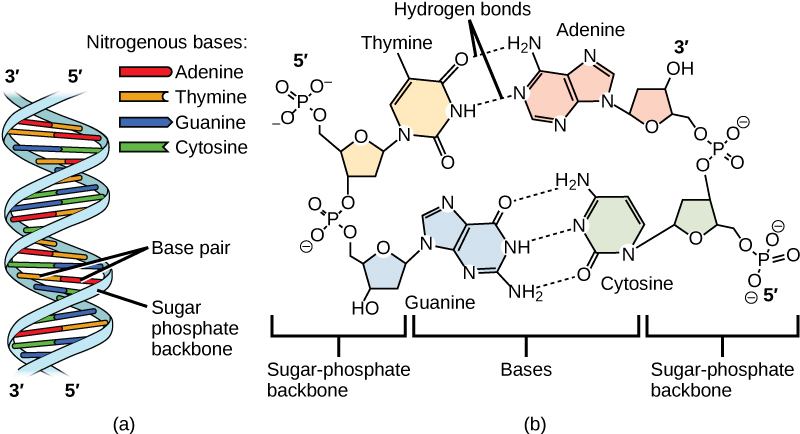
The phosphate group of one nucleotide bonds covalently with the sugar molecule of the next nucleotide, and then on, forming a long polymer of nucleotide monomers. The sugar–phosphate groups line upwardly in a "courage" for each single strand of DNA, and the nucleotide bases stick out from this backbone. The carbon atoms of the five-carbon saccharide are numbered clockwise from the oxygen as i′, 2′, 3′, 4′, and 5′ (1′ is read as "one prime"). The phosphate group is attached to the 5′ carbon of i nucleotide and the 3′ carbon of the side by side nucleotide. In its natural state, each DNA molecule is actually composed of two single strands held together along their length with hydrogen bonds between the bases.
Watson and Crick proposed that the DNA is made up of 2 strands that are twisted around each other to form a right-handed helix, called a double helix. Base of operations-pairing takes place between a purine and pyrimidine: namely, A pairs with T, and G pairs with C. In other words, adenine and thymine are complementary base of operations pairs, and cytosine and guanine are also complementary base pairs. This is the ground for Chargaff's rule; because of their complementarity, there is every bit much adenine as thymine in a Deoxyribonucleic acid molecule and equally much guanine as cytosine. Adenine and thymine are connected by two hydrogen bonds, and cytosine and guanine are connected by three hydrogen bonds. The two strands are anti-parallel in nature; that is, i strand will take the 3′ carbon of the sugar in the "upward" position, whereas the other strand will have the 5′ carbon in the upward position. The diameter of the DNA double helix is uniform throughout because a purine (2 rings) always pairs with a pyrimidine (1 ring) and their combined lengths are always equal. (Figure 9.4).
The Structure of RNA
There is a second nucleic acrid in all cells called ribonucleic acid, or RNA. Similar DNA, RNA is a polymer of nucleotides. Each of the nucleotides in RNA is made up of a nitrogenous base, a five-carbon sugar, and a phosphate group. In the example of RNA, the five-carbon saccharide is ribose, non deoxyribose. Ribose has a hydroxyl group at the ii′ carbon, dissimilar deoxyribose, which has merely a hydrogen atom (Figure 9.5).
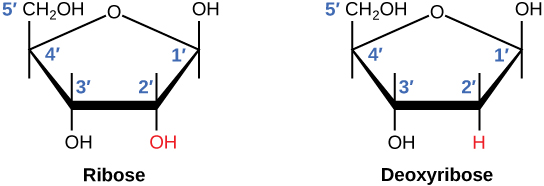
RNA nucleotides contain the nitrogenous bases adenine, cytosine, and guanine. However, they do not comprise thymine, which is instead replaced by uracil, symbolized past a "U." RNA exists as a unmarried-stranded molecule rather than a double-stranded helix. Molecular biologists have named several kinds of RNA on the basis of their role. These include messenger RNA (mRNA), transfer RNA (tRNA), and ribosomal RNA (rRNA)—molecules that are involved in the production of proteins from the Deoxyribonucleic acid code.
How Deoxyribonucleic acid Is Bundled in the Cell
Dna is a working molecule; it must be replicated when a cell is gear up to split, and it must be "read" to produce the molecules, such as proteins, to bear out the functions of the cell. For this reason, the Deoxyribonucleic acid is protected and packaged in very specific ways. In addition, Dna molecules can be very long. Stretched end-to-end, the Deoxyribonucleic acid molecules in a single man cell would come to a length of about 2 meters. Thus, the DNA for a cell must be packaged in a very ordered way to fit and office within a structure (the jail cell) that is not visible to the naked eye. The chromosomes of prokaryotes are much simpler than those of eukaryotes in many of their features (Figure 9.6). Most prokaryotes incorporate a single, circular chromosome that is constitute in an area in the cytoplasm chosen the nucleoid.
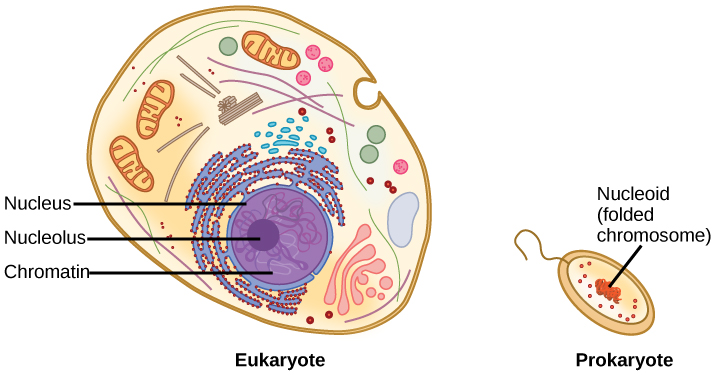
The size of the genome in one of the most well-studied prokaryotes, Escherichia coli, is iv.6 million base pairs, which would extend a distance of near 1.6 mm if stretched out. Then how does this fit inside a pocket-size bacterial prison cell? The DNA is twisted beyond the double helix in what is known as supercoiling. Some proteins are known to be involved in the supercoiling; other proteins and enzymes aid in maintaining the supercoiled structure.
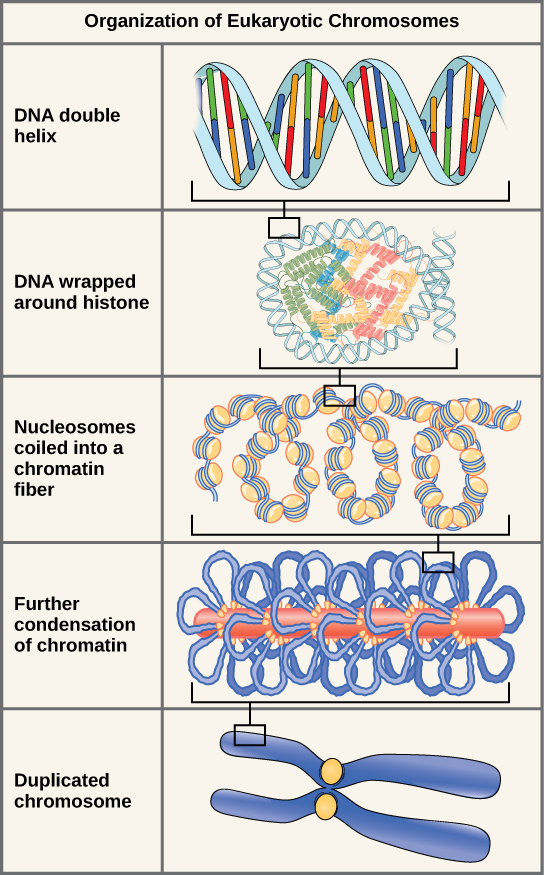
Eukaryotes, whose chromosomes each consist of a linear Dna molecule, utilise a different blazon of packing strategy to fit their Deoxyribonucleic acid inside the nucleus. At the about bones level, DNA is wrapped effectually proteins known as histones to form structures chosen nucleosomes. The Dna is wrapped tightly around the histone core. This nucleosome is linked to the next 1 past a brusk strand of DNA that is gratis of histones. This is also known as the "beads on a string" structure; the nucleosomes are the "beads" and the short lengths of Deoxyribonucleic acid between them are the "string." The nucleosomes, with their Dna coiled effectually them, stack compactly onto each other to class a 30-nm–broad fiber. This fiber is farther coiled into a thicker and more compact structure. At the metaphase stage of mitosis, when the chromosomes are lined upwards in the center of the jail cell, the chromosomes are at their nigh compacted. They are approximately 700 nm in width, and are found in association with scaffold proteins.
In interphase, the phase of the cell cycle between mitoses at which the chromosomes are decondensed, eukaryotic chromosomes have 2 distinct regions that can exist distinguished by staining. There is a tightly packaged region that stains darkly, and a less dense region. The darkly staining regions usually comprise genes that are non active, and are found in the regions of the centromere and telomeres. The lightly staining regions commonly contain genes that are agile, with Dna packaged around nucleosomes but not further compacted.
Concept in Activeness

Picket this animation of Dna packaging.
Department Summary
The model of the double-helix construction of Dna was proposed by Watson and Crick. The Deoxyribonucleic acid molecule is a polymer of nucleotides. Each nucleotide is equanimous of a nitrogenous base, a 5-carbon carbohydrate (deoxyribose), and a phosphate grouping. At that place are 4 nitrogenous bases in Dna, 2 purines (adenine and guanine) and two pyrimidines (cytosine and thymine). A DNA molecule is equanimous of 2 strands. Each strand is equanimous of nucleotides bonded together covalently between the phosphate grouping of one and the deoxyribose sugar of the next. From this backbone extend the bases. The bases of one strand bond to the bases of the 2d strand with hydrogen bonds. Adenine ever bonds with thymine, and cytosine always bonds with guanine. The bonding causes the ii strands to spiral around each other in a shape called a double helix. Ribonucleic acid (RNA) is a second nucleic acrid plant in cells. RNA is a single-stranded polymer of nucleotides. It as well differs from Deoxyribonucleic acid in that it contains the saccharide ribose, rather than deoxyribose, and the nucleotide uracil rather than thymine. Diverse RNA molecules office in the process of forming proteins from the genetic code in DNA.
Prokaryotes contain a single, double-stranded round chromosome. Eukaryotes contain double-stranded linear Dna molecules packaged into chromosomes. The Deoxyribonucleic acid helix is wrapped around proteins to grade nucleosomes. The poly peptide coils are further coiled, and during mitosis and meiosis, the chromosomes go even more greatly coiled to facilitate their motility. Chromosomes have two distinct regions which tin can be distinguished by staining, reflecting different degrees of packaging and adamant by whether the DNA in a region is being expressed (euchromatin) or not (heterochromatin).
Glossary
deoxyribose: a five-carbon saccharide molecule with a hydrogen atom rather than a hydroxyl group in the 2′ position; the sugar component of Dna nucleotides
double helix: the molecular shape of DNA in which 2 strands of nucleotides current of air around each other in a spiral shape
nitrogenous base: a nitrogen-containing molecule that acts equally a base; ofttimes referring to 1 of the purine or pyrimidine components of nucleic acids
phosphate group: a molecular group consisting of a primal phosphorus cantlet bound to four oxygen atoms
Source: https://opentextbc.ca/biology/chapter/9-1-the-structure-of-dna/
Posted by: johnsonyoubtand.blogspot.com
0 Response to "What Does The Data Show About The Makeup Of Dna For Different Species?"
Post a Comment